

Callaway Apex 21 vs TaylorMade P790 Irons for Mid Handicappers on a Budget this Spring Season 2026
If you are a mid-handicapper looking to drop shots, you are likely staring at two names that pop up in every equipment conversation: the Callaway Apex 21 and the TaylorMade P790. These are the gold standards of the "players-distance" category. They aren't game-improvement clubs that look like bricks, but they aren't blade irons that punish you for a millimeter of error either. They sit in that sweet spot where forgiveness meets workability.
However, the market is flooded with noise. You will see listings for "Apex 21" mixed with "Apex 24" or "P790" mixed with "P770," and it is easy to get confused about what you are actually buying. This comparison cuts through the marketing hype. I am going to break down exactly how these irons perform off the face, how they feel at impact, and which one actually helps your scorecard more—whether you are a 15-handicap trying to break 80 or a 25-handicap trying to break 90.
Affiliate disclosure: if you buy through these links, we may earn a commission at no extra cost to you.
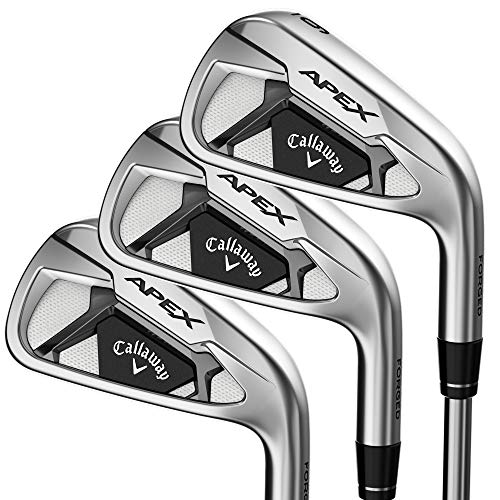
Table of Contents
Models in this comparison
Affiliate disclosure: if you buy through these links, we may earn a commission at no extra cost to you.

Quick Verdict
Choose Callaway Apex 21 if...
- You want maximum feel and control: You prefer a softer impact sensation and want to shape shots intentionally around the course.
- You value a premium look at address: You like the thin top line and compact profile that inspires confidence for better players.
- You are a mid-to-low handicapper: You have a consistent swing and want irons that offer precise distance control without sacrificing too much distance.
Choose TaylorMade P790 if...
- You need maximum distance and forgiveness: You want the "hot spot" technology that maximizes ball speed on off-center hits.
- You are a higher mid-handicapper (15-25): You need help getting the ball in the air and want a larger sweet spot.
- You want a modern, tech-forward feel: You prefer the sound and vibration dampening of the PWR-Cor technology.
| Factor | Callaway Apex 21 | TaylorMade P790 |
|---|---|---|
| Price Range | $1,100 - $1,300 (Set of 7-8) | $1,000 - $1,200 (Set of 7-8) |
| Best For | Skilled players seeking feel and workability | Mid-handicappers seeking distance and forgiveness |
| Setup Difficulty | Moderate (Requires consistent strike) | Easy (Forgiving on mishits) |
| Reliability | High (Consistent spin and trajectory) | High (Consistent distance gapping) |
| Key Advantage | Superior turf interaction and soft feel | Higher ball speed and launch assistance |
| Main Drawback | Less forgiving on extreme mishits | Can feel slightly "hot" or less workable |
About Callaway Apex 21
The Callaway Apex 21 is often described as the "last players' iron" before you step into a pure blade. It uses Callaway's "Forged Carbon" cavity back, which is essentially a urethane microsphere injected into the cavity to dampen vibrations. The result is an iron that feels incredibly soft at impact—almost like a muscle-back—but maintains the distance of a game-improvement club.
From a technical standpoint, the Apex 21 features Callaway's "Flash Face Cup" technology. This means the face is thinner and more flexible at the top and bottom, allowing for higher ball speeds even on low-face strikes. However, the Apex 21 prioritizes spin control. It generates consistent spin rates across the face, meaning you can trust that your 7-iron will land at the same spot every time. The look at address is compact, with a thin top line that appeals to better players. It doesn't look like a "help" club, which is a psychological advantage for many golfers.
About TaylorMade P790
The TaylorMade P790 is the benchmark for "players-distance" irons. Its standout feature is the PWR-Cor: a lightweight polymer insert in the cavity that lowers the center of gravity (CG) and increases MOI (Moment of Inertia). This makes the iron more forgiving on mishits while still allowing for a compact look.
TaylorMade uses "Speed Pocket" technology—a slot in the sole behind the face—that flexes more on low-face strikes, preserving ball speed and launch angle. For mid-handicappers, this is crucial. If you tend to hit the ball thin, the P790 will still get it airborne and keep it close to your target line. The sound at impact is slightly more muted and "thuddy" compared to the Apex 21's crisp "ping." It feels modern and tech-heavy, which appeals to golfers who want to feel like they are using the latest engineering.
Head-to-Head: Distance and Ball Speed
When it comes to raw distance, the TaylorMade P790 has a slight edge, particularly on off-center hits. The PWR-Cor technology allows for a larger effective hitting area, meaning if you strike the ball on the toe or heel, you lose less distance than you would with the Apex 21. For a mid-handicapper who might not strike the ball perfectly every time, this consistency in distance gapping is valuable.
The Callaway Apex 21 is not far behind on center strikes. Its Flash Face Cup technology ensures high smash factor across the face. However, the Apex 21 is designed more for precision than pure distance. If you are a low-handicap player who strikes the ball well, you might find the Apex 21's distance more predictable. But for the average mid-handicapper, the P790's ability to maintain speed on mishits makes it the more reliable distance tool.
Head-to-Head: Feel and Sound
Feel is subjective, but there is a clear difference here. The Apex 21 feels significantly softer and more "forged." If you prefer the sensation of a traditional blade, the Apex 21 delivers that premium feedback. It tells you exactly where you struck the ball, which is helpful for shot-shaping but can be punishing on severe mishits.
The P790 feels more dampened and solid. TaylorMade has done a great job of eliminating the harsh "tinny" sound that some cavity backs produce. It feels stable and confident. For golfers who are sensitive to vibration or who simply prefer a quieter iron, the P790 is the winner. It doesn't punish mishits as audibly or physically as the Apex 21.
Head-to-Head: Workability and Control
If you want to shape shots—hit a draw or a fade—the Apex 21 is the superior tool. Its compact head size and thin top line make it easier to manipulate at address. The spin characteristics allow for more aggressive shot shaping without the ball ballooning or hooking excessively. Better players will appreciate this level of control.
The P790 is more "straight and long." While you can still shape shots with it, the larger cavity and higher MOI make it slightly more resistant to twisting on off-center hits. This is actually a benefit for mid-handicappers who want the ball to go where they aim, rather than where the clubface decides. If your goal is accuracy over shape, the P790 is the better choice.
Who Should Choose Callaway Apex 21?
Choose the Callaway Apex 21 if you are a single-digit to low-single-digit handicapper who strikes the ball consistently. You value feel and workability over maximum forgiveness. You are willing to trade a little distance on mishits for a more premium experience and precise shot-making ability. If you are a better player looking for your next upgrade from game-improvement irons, the Apex 21 is the perfect bridge.
Who Should Choose TaylorMade P790?
Choose the TaylorMade P790 if you are a mid-handicapper (10-25) who wants more distance and forgiveness. You might not strike the ball perfectly every time, and you want an iron that helps you on mishits. If you prioritize straight shots and consistent distance gapping over the ability to shape shots, the P790 is the more practical choice. It is also ideal for golfers who prefer a softer, more muted feel at impact.
Our Verdict
For the specific audience of "mid-handicappers on a budget," the TaylorMade P790 is the more practical and beneficial choice. While the Apex 21 is a beautiful iron, it is designed for players who can consistently find the center of the face. The P790's PWR-Cor technology provides the forgiveness that mid-handicappers actually need to lower their scores. It helps you maintain distance on mishits and keeps the ball in the air more easily. The Apex 21 is a better iron for better players; the P790 is a better tool for improving your game.
Frequently Asked Questions
Are the Apex 21 and P790 similar in price?
Yes, both sets typically retail in the $1,100-$1,300 range for a 7-8 iron set. However, since both are previous generation models, you can often find significant discounts on the used market, with the P790 sometimes being slightly more affordable due to higher availability.
Which iron is better for a high handicapper?
Neither is ideal for a high handicapper (20+). Both are "players-distance" irons. A high handicapper would benefit more from game-improvement irons like the Callaway Big Bertha or TaylorMade Stealth HD, which offer more offset and a larger sweet spot.
Can I mix Apex 21 and P790 irons?
Technically, you can, but it is not recommended. The feel, sound, and distance gapping are different between the two. Mixing them can lead to confusion in your bag and inconsistent performance. Stick to one set for best results.
Do these irons come with shafts?
Yes, both are sold as complete sets. The Apex 21 typically comes with True Temper Dynamic Gold 105 or Nippon N.S. Pro Modus3 Tour 120 shafts. The P790 comes with Mitsubishi Chemical Kuro Kage 70 or Graphite Design Tour AD DI 7X shafts. Always verify the shaft flex and model when buying used.
Which iron has better turf interaction?
The Callaway Apex 21 generally has better turf interaction due to its narrower sole and more traditional blade-length design. It cuts through tight lies more easily. The P790 has a slightly wider sole for stability, which can be beneficial in rough but might feel slightly less precise on tight lies.

